
Welcome back to The Grant Catalyst, your deep dive into the mechanics of high-impact funding. Data proves your efficacy, but storytelling proves your humanity. In an era of automated reviewing and algorithmic screening, a compelling story is the only thing that can bypass a reviewer's "autopilot" and land straight in their "empathy center."
A story doesn't just describe a problem; it creates a witness. When you move a funder from being a passive observer of your metrics to an active participant in your mission, the nature of the transaction changes. You are no longer asking for a line item in their budget - you are inviting them to be a co-author of a solution.
Why Narrative is the New Currency
-
The "So What?" Factor: While your logic model explains the what, your story explains the why.
-
Memorability: Reviewers may forget your exact success rate, but they will never forget the name and face of the one individual whose life was irrevocably changed by your intervention.
-
Trust Building: A narrative that acknowledges the struggle, the pivot, and the triumph builds a level of authenticity that a sanitized data set simply cannot replicate.
In a world of high-tech submissions, don’t forget the high-touch reality: Grants are awarded by people, for people.

Strategy Spotlight
Grantmakers aren’t just looking for spreadsheets and logic models; they are looking for a reason to believe. While data proves your efficacy, storytelling proves your humanity. A compelling narrative transforms a dry proposal into a living mission that a funder feels compelled to join.
Here are four reasons why your story is the heartbeat of your grant application:
1. It Bridges the Empathy Gap
Data points like "helping 500 families" are impressive but also abstract. A story about one specific person - their hurdles, their turning point, and their success - allows a reviewer to step into their shoes. It moves the proposal from the "head" (logic) to the "heart" (impact).
2. It Makes Your Organization Memorable
Reviewers often read dozens of applications in a single sitting. They might forget the exact percentage of your growth, but they will remember the anecdote about the student who used your program to become the first college graduate in their family. Stories stick where statistics slip.
3. It Demonstrates "The Why"
Foundations don't just fund activities; they fund solutions to problems. A well-told story illustrates the urgency of the need. By painting a vivid picture of the "before" and "after," you show the grantmaker exactly how their investment acts as the bridge between a crisis and a solution.
4. It Showcases Your Cultural Competence
Sharing stories (with permission and dignity) demonstrates that you truly know the community you serve. It proves you aren't just observing from a distance; you are on the ground, listening to the voices of those you help. This builds trust and credibility with the funder.
Pro Tip: When telling a story in a grant, ensure the participant is the hero of the narrative, not your organization. Your nonprofit is the guide or the tool that helped the hero achieve their goal.
Featured Grants
Here are a few relevant and timely grant opportunities across different sectors that might be of interest:
Chick-fil-A Foundation Inc True Inspiration Awards. Grant Amount: $30,000 - US $350,000. Deadline: May 01, 2026. The program supports nonprofit organizations making an impact in their local communities. Organizations will be awarded for their work in one of these areas: Caring for People, Caring through Food, Caring for Communities, and Caring for Our Planet.
Max and Victoria Dreyfus Foundation Grant. Grant amount: US $1,000 - US $20,000. Deadline: May 10, 2026. The Foundation will consider requests to support museums, cultural and performing arts programs; schools and hospitals; educational, skills-training, and other programs for youth, seniors, and persons with disabilities; environmental and wildlife protection activities; and other community-based organizations and programs.
California Humanities - Connecting California - Quick Grants. Deadline: May 04, 2026. Grant Amount: $1,000-$5,000. Connecting California supports publicly accessible activities and events that strengthen social connection and cohesion across California’s diverse communities. Funded projects help foster understanding, empathy, and trust by creating opportunities for people to come together across differences and discover shared values, experiences, and aspirations.
Alaska Airlines Corporate Giving. Grant Amount: Unspecified; Deadline: Rolling. Alaska Airlines believes in strengthening and supporting the communities our employees, neighbors, and guests call home. We have key areas of focus where we believe Alaska Airlines can make the biggest impact in the communities we serve. They include: youth success, career readiness, care and belonging, environmental sustainability, and community resiliency.
TIP! One of the databases we use is Instrumentl. It’s robust and provides plenty of opportunities for you to research and build your grant pipeline. Want to give it a try? Try Instrumentl free for 14 days: https://www.instrumentl.com?grsf=4b33ig
Resources
On April 15, 2026, we launched a NEW PODCAST! It’s a co-branded video series with Keri McDonald and Valerie A. Grant called McGrants – Drive-Through Moments, which aired on 4/15/2026.
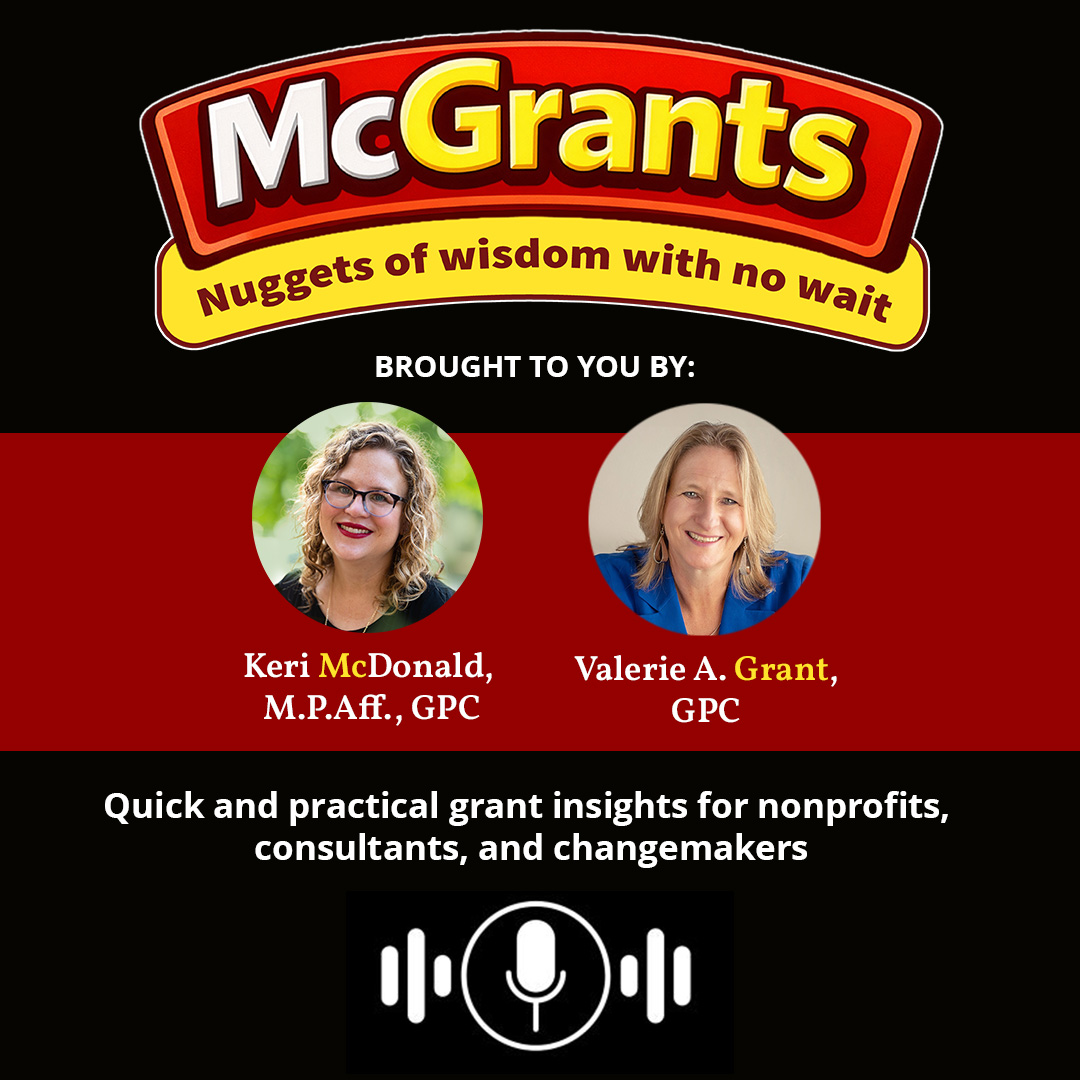
This is a short-form content series (10 minutes or less per episode) designed to provide practical, real-world insights on everything related to grants for nonprofit leaders and grant professionals.
The series is hosted by Keri McDonald (Keri McDonald Consulting LLC) and Valerie A. Grant (Grant Consulting Services LLC), both Grant Professionals Certified (GPC), and reflects decades of combined experience in grant development, strategy, and funding.
Each episode focuses on a specific topic, such as grant readiness, funder alignment, and pipeline strategy, and is designed to be immediately actionable.
The purpose of this series is to:
• Strengthen thought leadership in the field
• Provide value to our audience in a time-efficient format
Q&A Corner - Get Your Frequently Asked Questions Answered
Q: Can we apply for a grant to cover expenses we’ve already paid?
A: Generally, no. Most grants are "prospective," meaning they fund future work. Spending that occurs before the official "Award Date" is typically considered an ineligible expense. Always wait for the signed award letter before making major purchases.
Q: What is the "Statement of Need" or the problem you are addressing?
A: This is where you explain the "Why." Avoid generalities; use specific data and community stories to prove the problem exists.
Pro Tip: Instead of saying "Many children are hungry," say "In our county, 1 out of 4 children lacks access to a stable meal after school hours."
That's all for this month, folks! Remember, we're stronger together. Keep engaging, keep learning, and keep growing.
Until next time, Team GCS signing off!
Responses