
Welcome back to The Grant Catalyst, your deep dive into the mechanics of high-impact funding. Being grant-ready is no longer enough. Organizations have to be “more” than just grant-ready in the current grant funding landscape. Given the current administration, federal cuts, inflation, philanthropic changes, and more, organizations have to be strategic when applying for grants. Basic "grant readiness" - having your tax-exempt paperwork, basic budgets, and audit files in order - is merely the price of admission. With shifting government budgets and increased competition for private philanthropic dollars, foundations and institutional donors no longer just evaluate whether an organization can manage a grant; they assess whether the organization is strategically positioned to maximize its impact.
Strategy Spotlight
Moving beyond basic readiness means building organizational resilience, cultivating deep funder alignment, and treating grants as a calculated driver of long-term sustainability rather than a temporary fix for operating deficits. To transition from baseline grant readiness to a competitive, strategic grant-seeking posture, nonprofits should implement the following strategies:
-
Diversify and Blend Revenue Streams: Avoid relying on grant funding as the sole lifeline for core operations. Structure grant applications to target specific funding programs while balancing your overall revenue mix across individual donors and corporate sponsors to insulate against sudden funder pivots.
-
Align Applications with True Cost Accounting: Stop underfunding overhead out of fear of looking inefficient. Calculate the full cost of project delivery - including shared administrative time, indirect software, space, and evaluation costs - and request funding that reflects actual operational expense, ensuring new grants don't create internal budget deficits.
-
Shift from Output Metrics to Impact Evaluation: Move past tracking basic activity metrics (e.g., number of meals served or workshops held) and focus on long-term systemic outcomes and data-driven impact stories. Institutional funders favor organizations with robust, pre-built evaluation frameworks that prove measurable community change.
-
Build Funder Relationships Before the RFP: Proactively engage program officers, participate in community coalitions, and articulate your mission long before grant applications open. Establishing trusted, relational connections - rather than purely transactional ones - significantly increases funding likelihood and opens doors to multi-year investments.
Featured Grants
Here are a few relevant and timely grant opportunities across different sectors that might be of interest:
The H.B. Fuller Company Foundation. Deadline: August 31, 2026. Grant amount: US $10,000 - US $25,000. Through its Fuller Impact Global Grantmaking Program (effective 2026), the Foundation advances two primary focus areas: STEM Education and Youth Leadership Development. It prioritizes measurable, long-term impact, fostering collaboration, capacity building, and catalytic investments that reflect H.B. Fuller’s core values and commitment to innovation and access.
Ittleson Foundation. LOI due September 01, 2026. Amount: Varies. The Foundation recognizes not-for-profit organizations dedicated to funding new initiatives and model projects that have the potential to greatly enhance public policy and the lives of fellow citizens. The Foundation's areas of particular interest are: mental health, AIDS, and the environment.
The Bolger Foundation. Deadline: September 01, 2026. Amount: $10,000 - $250,000. The mission of The Bolger Foundation is to inspire individuals and support charitable organizations, empowering them to better serve their communities and the world through these focus areas: conservation and preservation; those who are underprivileged and underserved; health, including mental health; community; and education. The Bolger Foundation supports capital projects.
The Larry H. & Gail Miller Family Foundation. Deadline: September 01, 2026. Amount: Up to $10,000. The Foundation is dedicated to enriching lives and communities by partnering with 501(c)(3) nonprofits that provide services and equitable access in the following areas: Health and Medicine, Shelter and Food Security, Education and Skill Development, Jobs and Economic Self-reliance, & Cultural and Spiritual Enrichment.
TIP! One of the databases we use is Instrumentl. It’s robust and offers plenty of opportunities to research and build your grant pipeline. Want to give it a try? Try Instrumentl free for 14 days: https://www.instrumentl.com?grsf=4b33ig
Resources
Don't forget to tune into our NEW PODCAST! It’s a co-branded audio series with Keri McDonald and Valerie A. Grant called McGrants – Drive-Through Moments.
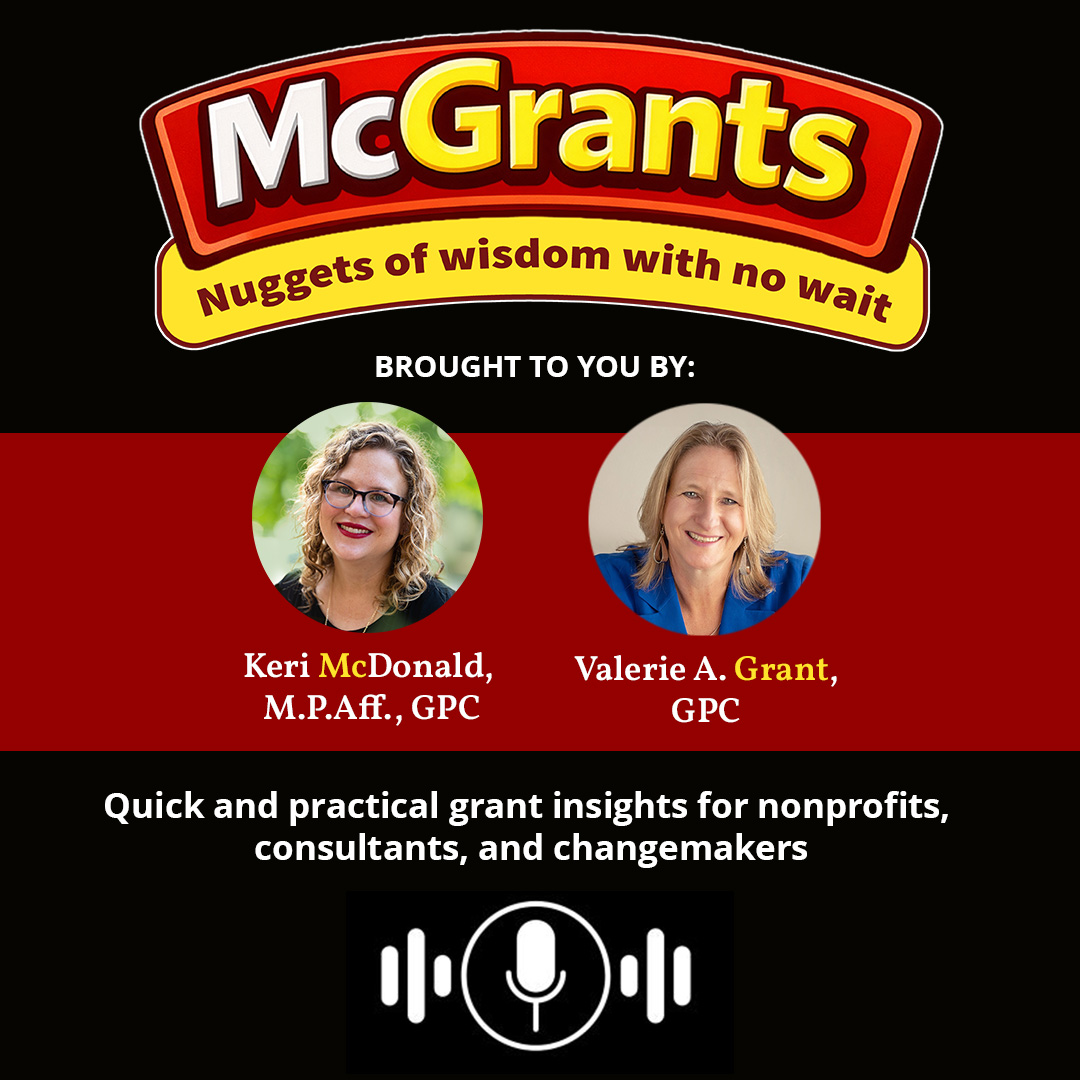
This is a short-form content series (10 minutes or less per episode) designed to provide practical, real-world insights on everything related to grants for nonprofit leaders and grant professionals.
The series is hosted by Keri McDonald (Keri McDonald Consulting LLC) and Valerie A. Grant (Grant Consulting Services LLC), both Grant Professionals Certified (GPC), and reflects decades of combined experience in grant development, strategy, and funding.
NEW EPISODES DROP EVERY WEDNESDAY! Check us out WEEKLY HERE!
Q&A Corner - Get Your Frequently Asked Questions Answered
Q: What is the fundamental difference between a government grant and a foundation grant?
A: Government grants (federal, state, or local) typically offer much larger funding amounts, but they come with rigorous compliance requirements, strict reporting mandates, and complex application processes. Foundation grants (private, community, or corporate) are generally smaller and more flexible, but they rely heavily on alignment with the funder’s specific mission and often require building a long-term relationship before or during the application process.
Q: What role does a Logic Model or Theory of Change play in strategic grant seeking?
A: A Logic Model is a systematic visual map linking your Inputs (resources, staff), Activities (what you do), Outputs (direct deliverables, like number of people served), and Outcomes (short- and long-term impact/change).
Funders look for Logic Models because they prove your project is grounded in clear, measurable logic rather than vague good intentions. It assures the funder that you know how to measure success.
That's all for this month, folks! Remember, we're stronger together. Keep engaging, keep learning, and keep growing.
Also, we remember the tragic events of September 11, 2001, honoring the lives lost, the brave first responders, and the families forever changed. Lessons of resilience are never forgotten.

Until next time, enjoy your Labor Day! Team GCS signing off!
Responses