
Welcome back to The Grant Catalyst, your deep dive into the mechanics of high-impact funding. In the increasingly competitive landscape of grantmaking, data and statistics are essential for establishing credibility, but the need for funding must also be demonstrated. The needs statement is the foundational pillar of your grant proposal; it establishes the entire justification for your project's existence. Potential funders look to this section to understand the precise reality of the problem you are tackling, supported by localized data and community context.
Consider that a well-defined needs statement sets the baseline against which all future project impact is measured. Funders view their grants as investments, and they want to see a clear "before and after" picture. If the baseline need is vague, it becomes impossible to prove how your proposed intervention will move the needle. A sharp, undeniable description of the gap in services or resources creates a sense of urgency that convinces the funder that their financial support will act as a direct catalyst, resulting in a high-impact, measurable turnaround for the population you serve.

Strategy Spotlight
Tips to Master the Needs Statement
Mastering the needs statement requires a strategic approach that clearly translates community challenges into a compelling case for support. By focusing on data-driven evidence, community voices, and a clear scope, organizations can build a bulletproof foundation for any proposal. Here are four essential tips to help you craft a powerful and persuasive needs statement:
-
Focus on the Community, Not Your Organization: Frame the need in terms of the challenges faced by your target population, not your organization’s lack of funding or staff. Funders invest in solving societal problems, not balancing your operational budget.
-
Use Data to Build an Undeniable Case: Support your narrative with fresh, relevant statistics, census data, or stories from local focus groups. Showing that you intimately understand the quantitative data proves you are an expert on this specific issue.
-
Establish a Direct Link to the Solution: Ensure the need you describe perfectly mirrors the activities you propose later in the application. If your needs statement highlights a lack of youth literacy programs, your project shouldn't pivot to funding a general community playground.
-
Tie the Problem Directly to Your Ultimate Mission: Explicitly state why your organization is the right vehicle to address this specific crisis. Connect the dots for the funder so they see that solving this problem is a natural extension of your institutional history and values.
A compelling needs statement does not just list grievances; it directly connects the community's deficit to your organization's overall mission. By demonstrating that the problem falls squarely within your core expertise, you show funders that your organization isn't just chasing dollars, but is actively executing its long-term vision to drive meaningful change.
Featured Grants
Here are a few relevant and timely grant opportunities across different sectors that might be of interest:
William E. Dean III Charitable Foundation. Grant Amount: US $5,000 - US $10,000. Deadline July 01, 2026. The Dean III Foundation was created exclusively for charitable, religious, scientific, literary and educational purposes. Program Types Funded include: Animal-Related; Education; Human Services; and, Religion-Related.
AstraZeneca Foundation - ACT on Health Equity Community Solutions Challenge Grant, Up to US $30,000. Deadline July 02, 2026. This year, the funder’s focus is on supporting programs that create meaningful impact across nutrition and food security, healthcare access, education, climate, and nature.
John Templeton Foundation Grant Program. Grant Amount: Unspecified. Letter of inquiry Deadline: Jul 15, 2026. The Foundation offers grants in support of research and public engagement in our major Funding Areas: character virtue development, individual freedom & free markets, life sciences, mathematical & physical sciences, public engagement, and religion: science & society.
SpartanNash Foundation. Grant Amount: Unspecified. Deadline: July 24, 2026. Through SpartanNash, our Heroes & Hope Foundation has supported more than $17 million to nonprofit partners, including organizations that: provide meals through food banks and pantries, deliver food and water during natural disasters, support veterans, military families and first responders, offer training and nutrition education for Special Olympics athletes, and equip young people with career and life skills
Elevance Health Foundation - Maternal and Child Health. Grant Amount: Unspecified. Deadline July 31, 2026. The Foundation will prioritize funding programs that improve maternal/infant health, target disparities, address social needs, and remove barriers to care throughout the pregnancy journey—from pre-conception support to postnatal care for mothers and babies. The programs should drive specific, measurable maternal/infant health outcomes.
TIP! One of the databases we use is Instrumentl. It’s robust and offers plenty of opportunities to research and build your grant pipeline. Want to give it a try? Try Instrumentl free for 14 days: https://www.instrumentl.com?grsf=4b33ig
Resources
Don't forget to tune into our NEW PODCAST! It’s a co-branded audio series with Keri McDonald and Valerie A. Grant called McGrants – Drive-Through Moments, which launched on 4/15/2026.
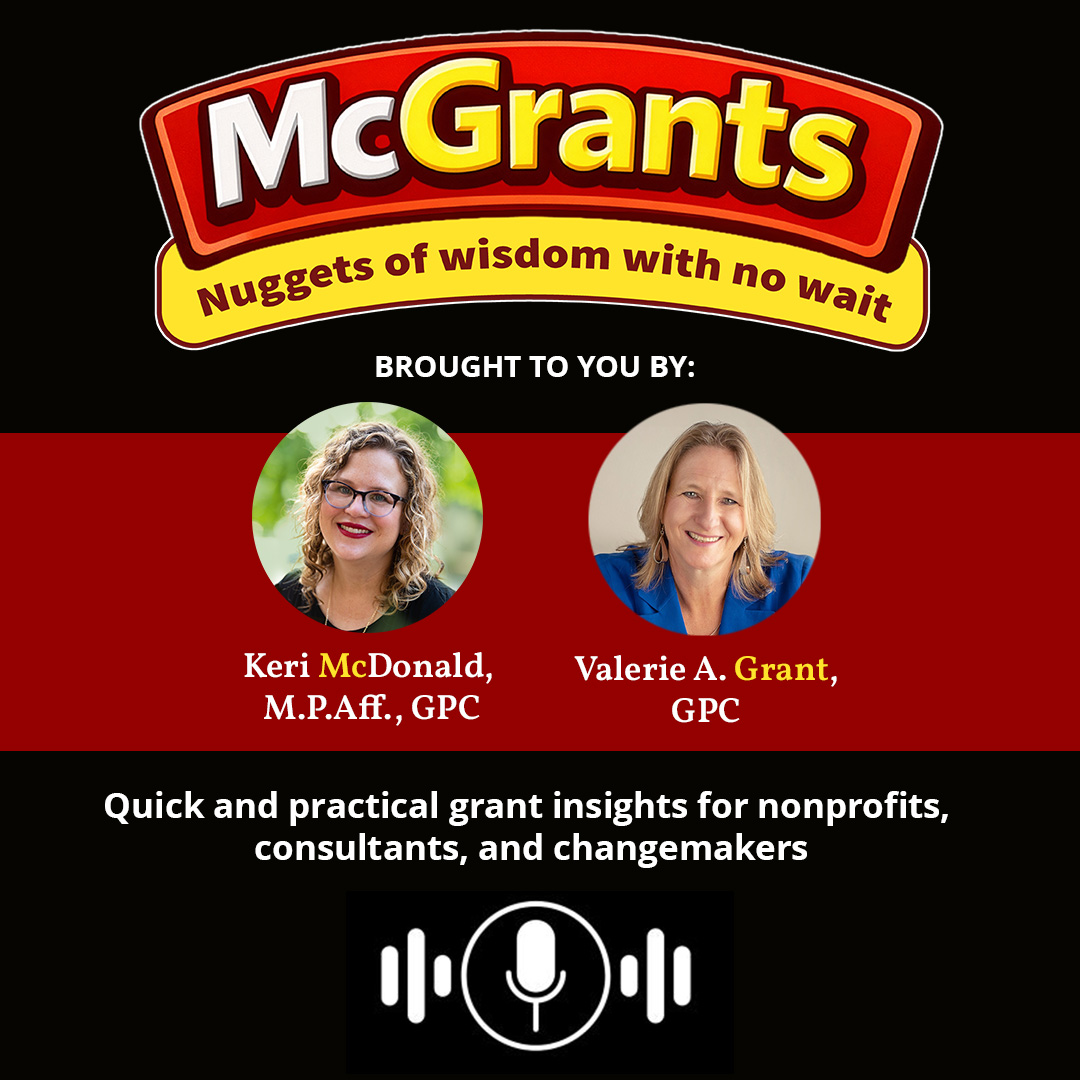
This is a short-form content series (10 minutes or less per episode) designed to provide practical, real-world insights on everything related to grants for nonprofit leaders and grant professionals.
The series is hosted by Keri McDonald (Keri McDonald Consulting LLC) and Valerie A. Grant (Grant Consulting Services LLC), both Grant Professionals Certified (GPC), and reflects decades of combined experience in grant development, strategy, and funding.
NEW EPISODES DROP EVERY WEDNESDAY! Check us out WEEKLY HERE!
Q&A Corner - Get Your Frequently Asked Questions Answered
Q: What does "grant matching" or "cost-sharing" mean, and do we have to use cash?
A: Grant matching means the funder requires your organization to contribute a percentage of the total project cost. For example, a 50% match on a $100,000 grant means you must bring $50,000 of your own resources to the table.
The good news is that matching doesn't always have to be hard cash. Many funders accept in-kind contributions. This includes the calculated value of volunteer hours, donated equipment, free venue space, or a percentage of an existing staff member's salary dedicated to the project. Always check the guidelines to see what types of matches are allowed.
Q: What is the single biggest reason otherwise great grant proposals get rejected?
A: Failure to follow instructions. It sounds overly simple, but grant reviewers look for reasons to eliminate applications early to narrow down the pile.
If a guide asks for a 5-page narrative, a 6-page submission is disqualified. If it specifies Arial 11-point font and 1-inch margins, using Times New Roman to squeeze in more text will get it tossed. Before content even matters, compliance is king. Always use a checklist to ensure you’ve met every formatting, structural, and attachment requirement down to the letter.
IN HONOR OF INDEPENDENCE DAY...
Celebrating Independence Day is a meaningful way to show support for the foundational values of liberty, unity, and resilience that shape a nation. It serves as a vital reminder of the shared sacrifices made by generations to secure freedom and self-determination. By participating in community traditions and reflecting on the journey toward equality, we honor that historic legacy while reaffirming our collective commitment to building a stronger, more inclusive future.

That's all for this month, folks! Remember, we're stronger together. Keep engaging, keep learning, and keep growing.
Until next time, Team GCS signing off!
Responses