
Welcome back to The Grant Catalyst, your deep dive into the mechanics of high-impact funding. While most people spend the final quarter of the year debating holiday menus and wrapping gifts, nonprofit professionals are busy with end-of-the-year fundraising. For nonprofits, the fourth quarter isn't just the end of the calendar - it is the financial foundation of the entire year.
According to the Blackbaud Institute (2026), 36.1% of annual charitable revenue is raised in the fourth quarter (Q4), and in December alone, it accounts for roughly 18% (or up to 30% depending on whether online or total giving is tracked) of all annual giving. Q4 serves as a vital bridge between immediate operational needs and long-term strategic growth. How an organization handles year-end fundraising directly sets the stage for stability and sustainability heading into the next fiscal year. Foundations are giving this quarter an extra push because these months are major revenue magnets, driven by tax-deadline motivation, holiday generosity, and GivingTuesday.

Strategy Spotlight
Navigating the Grant Funding Landscape
Grantmakers are increasingly looking for concrete, data-backed outcomes rather than vague promises of goodwill. Unrestricted general operating support has hit record highs, giving organizations much-needed breathing room, but competition for those flexible dollars is fierce. To make matters more interesting, corporate givers are doubling down on employee-driven matching programs, while traditional foundations are moving to invitation-only grant cycles, prioritizing community-led solutions and long-term legacy planning over one-off transactional projects.
While individual giving dominates year-end campaigns, grant funding remains a crucial engine for growth. To maximize Q4 grant opportunities and position your mission effectively for the coming year, you need a strategy in place.
Strategic Action Steps Going Into Next Year
To turn year-end momentum into sustainable funding throughout the coming year, nonprofit leaders should focus on a few practical preparation steps:
-
Build a Master Grant & Giving Calendar: Avoid last-minute scrambles by mapping out known foundation submission windows, reporting deadlines, and major giving campaigns across the upcoming months - at least 3 months, or even up to 12 months.
-
Double Down on Donor Retention: Because donor acquisition costs continue to rise, prioritize keeping first-time Q4 donors engaged through personalized follow-ups, automated thank-you workflows, and clear impact updates. Site visits work!
-
Audit Your Grant Readiness: Centralize core application materials - such as logic models, mission/vision, objectives, goals, leadership bios, audited financials, and key impact metrics - into a shared institutional folder so your team can respond to funding opportunities in a timely manner.
-
Leverage Matching Gifts & Corporate Grants: Capitalize on corporate philanthropy budgets that must be deployed before year-end. Ensure donation forms include simple matching-gift lookup tools.
By treating Q4 as a launching pad rather than just a finish line, nonprofits can secure immediate operational needs while building an agile, resilient foundation for the year ahead.
Source: 2025 Trends in Giving - Blackbaud Institute. Retrieved from https://institute.blackbaud.com/resources/2025-trends-in-giving
Featured Grants
Here are a few relevant and timely grant opportunities across different sectors that might be of interest:
American Psychological Foundation. LOI Deadline: October 30, 2026. Amount: Up to $60,000. The APF Direct Action Visionary Grants seek to fund innovative interventions, based on psychological knowledge, that directly address pressing needs of communities. Projects should support APF’s four Visionary Priorities: Serve Marginalized Communities, End Prejudice & Stigma, Prevent Violence, and Explore Mind-Body Health Connections
The Ann B. Zekauskas Family Foundation. Deadline: November 01, 2026. Amount Varies. The foundation welcomes grant requests from nonprofit organizations seeking to make a meaningful impact in their communities in the areas of nutritional education, food access, or the advancement of culinary arts careers.
Draper Richards Kaplan Foundation Grant. Rolling Deadline. Amount - up to $300,000. The foundation seeks to dramatically improve the lives of underserved communities across the globe by supporting scalable, innovative, and impact-first solutions that leverage existing systems and stakeholders through capacity and capital grant requests.
Max and Victoria Dreyfus Foundation Grant. Deadline: November 10, 2026. Amount: $1,000-$20,000. The Foundation will consider requests to support museums, cultural and performing arts programs; schools and hospitals; educational, skills-training, and other programs for youth, seniors, and persons with disabilities; environmental and wildlife protection activities; and other community-based organizations and programs.
Quest for Healthy Communities Champions Grant. Deadline: November 19, 2026. Amount: $10,000. Quest funds and scales evidence-based initiatives that promote wellness, prevent chronic disease, and empower individuals focused on three critical, interconnected clinical and social interventions to build sustainable health improvement: strengthening the community health workforce, addressing social drivers of health (SDoH), and promoting the prevention, early detection, monitoring, and treatment of disease through diagnostic testing.
TIP! One of the databases we use is Instrumentl. It’s robust and offers plenty of opportunities to research and build your grant pipeline. Want to give it a try? Try Instrumentl free for 14 days: https://www.instrumentl.com?grsf=4b33ig
Resources
Don't forget to tune into our NEW PODCAST! It’s a co-branded audio series with Keri McDonald and Valerie A. Grant called McGrants – Drive-Through Moments.
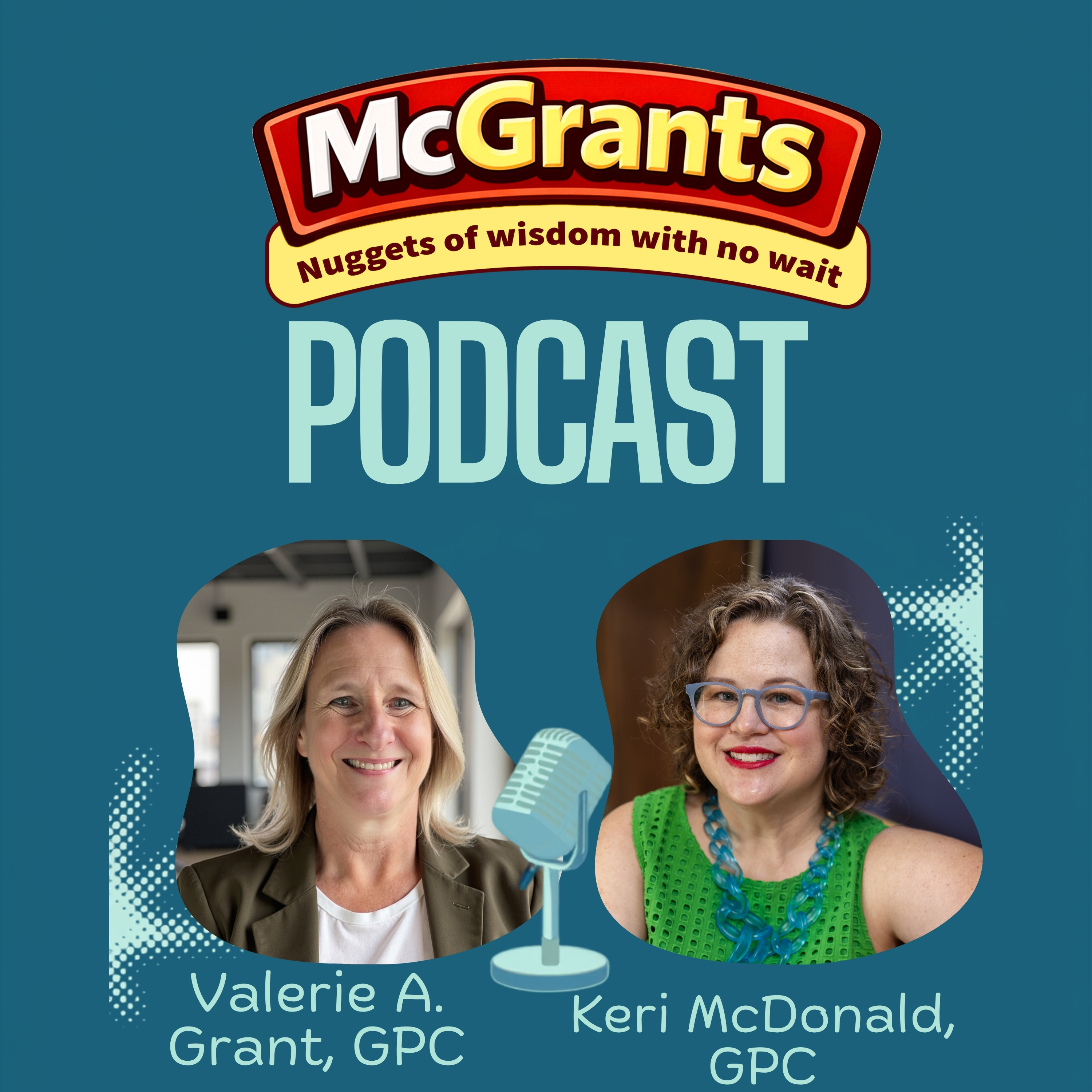
This is a short-form content series (10 minutes or less per episode) designed to provide practical, real-world insights on everything related to grants for nonprofit leaders and grant professionals.
The series is hosted by Keri McDonald (Keri McDonald Consulting LLC) and Valerie A. Grant (Grant Consulting Services LLC), both Grant Professionals Certified (GPC), and reflects decades of combined experience in grant development, strategy, and funding.
NEW EPISODES DROP EVERY WEDNESDAY! Check us out WEEKLY HERE!
Q&A Corner - Get Your Frequently Asked Questions Answered
Q: Who are the key personnel involved, and what is their expertise?
A: Highlight the qualifications of the Project Director and lead staff. Funders aren't just investing in an idea; they are investing in the people executing it. The goal is to show that your team has the technical skills and experience to manage the budget and hit the project milestones.
Q: What is the "Sustainability Clause" in a grant application, and why do funders care so much?
A: Funders want to know that their money is an investment, not a temporary band-aid. The sustainability section asks: "What happens to this project when our grant money runs out next year?" If your answer is "We will look for another grant," reviewers will likely pass. They want to see a tangible plan for long-term survival. Excellent answers include plans to transition the project to fee-for-service models, secure local government backing, launch individual donor campaigns, or demonstrate how the grant will build permanent infrastructure that won't require ongoing funding.
That's all for this month, folks! Remember, we're stronger together. Keep engaging, keep learning, and keep growing.
Happy Halloween!

Team GCS signing off!
Responses